

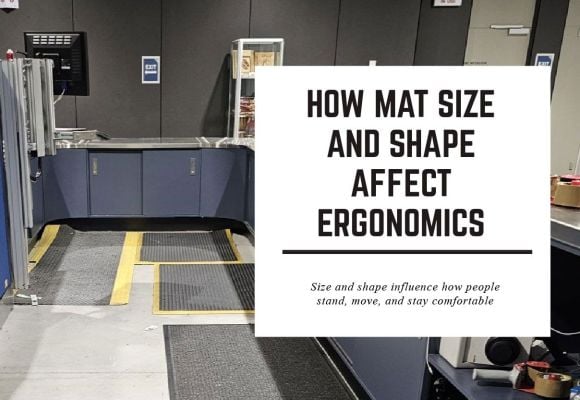
How Mat Size and Shape Affect Ergonomics
Ergonomics is not limited to chairs, desks, or screen height. For anyone working on their feet, the mat beneath them plays an equal role. Size and shape influence how people stand, move, and stay comfortable through long shifts. A mat chosen without thought can leave staff with sore joints, reduced concentration, and higher risks of slips. A well-selected mat, on the other hand, can support posture, distribute weight, and improve daily comfort.
Many workplaces already understand the value of anti-fatigue mats. The challenge lies in knowing how dimensions change their performance. From narrow counters to wide factory floors, each setting requires a tailored approach. Before choosing, it helps to start with a broad overview of what matters most. Our anti-fatigue mats buying advice gives readers that foundation, then size and shape refine the choice even further.
Why Ergonomics and Mat Design Go Hand in Hand
Ergonomics focuses on designing workspaces that reduce strain and support natural body movement. Standing for long hours on hard floors goes against that principle. Muscles tire, circulation slows, and workers begin to shift weight from one leg to another. Over time, that leads to discomfort, mistakes, and even injury.
Mats provide cushioning, but their design must align with the way people move. A narrow mat at a wide workstation forces staff to constantly step off the cushioned area. An oversized mat in a small office leaves edges bunched, increasing the risk of trips. Both outcomes defeat the purpose of investing in ergonomic flooring.
The right dimensions integrate into the workspace seamlessly. Workers can remain in natural positions without adjusting their stance or footing. Over time, the difference in fatigue levels is clear. Correct sizing reduces micro-strains that build up silently during long shifts.
The Impact of Mat Size on Comfort and Safety
Too Small Mats
Mats that are undersized leave gaps between the work area and the cushioned surface. This forces users to adjust their standing position or shuffle constantly to remain on the mat. Small mats are common in busy kitchens and behind retail counters, where they are purchased for a single standing spot but fail to cover the range of movement. The result is more fatigue and a higher chance of stepping onto wet or slippery tiles.
Oversized Mats
Large mats can also create issues. If they extend into walkways or cover areas not meant for standing, they may create clutter. Edges can curl or fold, presenting a safety risk. In some cases, an oversized mat makes cleaning more difficult, trapping dust or liquid under corners. Cost is another consideration—extra size without function wastes budget.
Finding the Right Fit
The best approach is a mat that matches the active area. For a cashier, this means covering the space behind the counter from side to side. For assembly line staff, mats should extend along the length of the workstation. Correct sizing keeps staff secure in their tasks without breaking natural movement.
When evaluating options, it helps to look at current anti-fatigue mat choices available in Australia, where different dimensions are suited to different environments. Some are compact for office use, while others are designed to run the length of industrial benches. Reviewing these variations gives a practical sense of how sizing impacts performance.
How Mat Shape Influences Ergonomics
Shape is often overlooked, yet it carries just as much weight as size. Different environments demand unique designs:
- Rectangular mats: Standard for most workplaces. Best suited for straight counters, packing benches, or uniform work areas.
- Curved mats: Designed to complement standing desks, they follow the arc of natural movement and encourage micro-adjustments that reduce stiffness.
- Modular tiles: These allow coverage of large or irregular spaces. They can be configured into corners, long aisles, or even full-room coverage.
- Runners: Long, narrow mats for production lines, corridors, or service counters.
Each shape impacts how people move. For example, contoured edges at a standing desk create a subtle rocking motion. This encourages weight shifts that ease lower back strain. Flat mats keep feet steady in environments where precision is important, such as laboratory or technical work.
For desk setups, many people debate between traditional mats and those with angled edges. In our view, the answer depends on posture and movement. Researching flat versus contoured mats designed for standing desks gives clear guidance on which style suits different tasks.
Online discussions also highlight how personal the experience can be. One user in a standing-desk forum mentioned that their feet grew tired within ten minutes on a hard floor, yet discomfort dropped by around half after switching to a firmer anti-fatigue mat of the right size. This kind of feedback illustrates how mat choice affects real people in daily use.
The Role of Material and Thickness
While the focus here is on size and shape, the material cannot be ignored. Foam mats that are too soft may encourage sinking, leading to joint instability. Conversely, overly firm surfaces feel closer to bare flooring and defeat the ergonomic benefit. The right balance comes from mats with enough cushioning to absorb impact without compromising stability.
Thickness also matters. Mats that are too thin provide little relief, while those too thick can make balance awkward. Workplace safety officers often review mats for both these qualities before approving them for regular use.
When considering material firmness, it helps to think about how foam that compresses too easily can affect long-term safety. Standing on a surface that feels unstable places extra strain on ankles and knees, undermining ergonomic design.
Ergonomics in Action: Productivity Benefits
The impact of size and shape extends beyond comfort. It influences workplace output. Fatigue leads to slower reaction times, reduced concentration, and more mistakes. A workforce standing on poorly fitted mats will show signs of lower productivity before the day ends.
Conversely, well-sized mats support energy levels. Staff remain focused, posture stays upright, and energy drains at a slower pace. Small improvements in daily stamina translate into measurable efficiency gains.
For businesses considering mats as part of their ergonomic planning, it is helpful to look at the relationship between mat design and productivity outcomes. Studies consistently show reductions in fatigue-related complaints and increases in efficiency once the right matting is introduced. Over time, this investment pays off in reduced absenteeism, improved morale, and safer work environments.
For businesses considering mats as part of their ergonomic planning, it is helpful to look at the relationship between mat design and productivity outcomes. An Australian systematic review published in Applied Ergonomics found moderate evidence that cushioned flooring, such as anti-fatigue mats, reduces musculoskeletal discomfort and fatigue among workers who stand for long periods (PubMed). These findings align with what many workplaces already report—less pain, more energy, and improved focus once mats are introduced. Over time, that translates into reduced absenteeism, higher morale, and safer work environments.
Choosing the Right Size and Shape for Different Settings
Mat dimensions need to be matched to specific workplace conditions. What works in a warehouse rarely suits a compact office. Below is a breakdown of common environments and the mat designs that fit them best.
Offices and Standing Desks
- Compact spaces benefit from smaller mats with shaped edges.
- Curved designs fit the natural stance of workers who lean, stretch, or swivel at adjustable desks.
- For static tasks, a flat, rectangular mat provides stability without movement.
- Staff can compare designs through resources that review ergonomic mat setups for desk users, making it easier to select between contoured and standard versions.
Retail Counters
- Cashiers often shift side to side. Mats should cover the full width of the counter.
- A narrow mat that leaves gaps can cause frequent stepping onto hard tiles, increasing fatigue.
- Long runners provide consistent coverage and prevent staff from standing on bare surfaces.
Industrial and Warehouse Floors
- Heavy-duty rectangular mats or interlocking tiles offer broad coverage.
- Length is the priority, as staff often move along benches or conveyor belts.
- Modular systems are effective where layouts change frequently.
Hospitality and Kitchens
- Kitchens require mats that drain water, grease, and food debris.
- Size must match the width of food preparation benches.
- Corners and doorways should be fitted with modular sections to prevent trip hazards.
- Hygiene regulations mean mats must be easy to lift and clean.
A useful starting point for all these settings is a buying guide for anti-fatigue mats, where material, surface design, and sizing are explained step by step. From there, workplaces can match specific requirements to their environment.
Comparing Size and Shape: Quick Reference Table
| Workplace Type | Ideal Mat Size | Suitable Shape | Key Benefits |
| Office desks | Compact, 80–120 cm width | Contoured or rectangular | Supports posture, fits under desk setups |
| Retail counters | 1.2–2.4m length runners | Narrow rectangular | Covers side-to-side movement |
| Warehouses | Long mats or modular tiles | Rectangular or modular | Coverage for production lines and benches |
| Kitchens | 1.5 - 3.0m | Rectangle with drainage | Slip resistance, hygiene, drainage channels |
| Service corridors | Long, continuous runners | Narrow rectangular | Safe walking routes, reduced fatigue |
This table summarises how different environments benefit from tailored mat choices. The focus is not only comfort but also safety and efficiency.
Case Example: Retail Counter Coverage
Consider a retail store where staff spend six hours per shift at checkout. The workspace is three metres wide, but the mats in use are just one metre. Staff constantly step onto bare tiles during transactions. Fatigue complaints are common, and slips occur near the uncovered sections.
Replacing the undersized mats with runners spanning the entire counter width reduces these problems immediately. Staff no longer need to shift position to stay on cushioned areas. Comfort improves, accidents decline, and productivity rises.
Situations like these highlight why dimensions cannot be overlooked. Small adjustments in mat size often have measurable ergonomic outcomes.
Linking Ergonomics to Workplace Performance
Correct mat size and shape do more than prevent discomfort. They tie directly to measurable business results.
- Reduced absenteeism: Staff standing on properly fitted mats report fewer musculoskeletal complaints.
- Improved concentration: Comfort supports longer periods of focus, particularly in precision work.
- Fewer accidents: Mats that cover active zones lower the likelihood of slips and falls.
- Higher efficiency: Fatigue reduction means tasks are performed more quickly and accurately.
Research supports these outcomes. Studies consistently show that staff provided with ergonomic matting experience less pain and greater productivity. Those findings align with our view that mat design should be treated as an investment rather than a basic supply expense.
Readers interested in deeper evidence can look at studies connecting mats with productivity improvements, where fatigue levels are measured before and after matting is introduced.
Key Considerations Before Buying
Selecting the right mat is not a one-step decision. Several points must be reviewed before purchase:
- Workstation dimensions – Measure the full width and depth of active areas. Coverage must align with staff movement patterns.
- Traffic flow – Walkways should remain clear. Mats must not extend into paths where carts or foot traffic are common.
- Cleaning requirements – Kitchens need drainage holes. Offices require mats that roll easily for vacuuming.
- Durability – Heavy-duty mats withstand trolleys, chairs, and foot traffic without compressing too quickly.
- Budget – Balance cost against lifespan and staff benefits. Spending more on the correct mat reduces long-term replacement and injury costs.
A short review of the current anti-fatigue mat options available in Australia can help buyers compare durability and price ranges before making a final decision.
How Shape Supports Ergonomic Goals
Shape deserves extra attention in design-focused workplaces. For example:
- Curved edges encourage subtle weight shifts. These movements aid circulation and reduce stiffness.
- Bevelled edges prevent trips when workers roll chairs or step on and off frequently.
- Custom-cut shapes suit irregular rooms or corners where standard mats leave gaps.
These design features influence posture, balance, and long-term comfort. Investing in shape-appropriate mats often has a stronger ergonomic impact than thickness alone.
Choosing Between Flat and Contoured Mats
Flat mats and contoured mats each serve different ergonomic goals.
-
Flat mats:
- Stable footing.
- Better for precision tasks such as assembly or laboratory work.
- Easier for cleaning and equipment use.
-
Contoured mats:
- Encourage micro-movements that prevent stiffness.
- Popular in offices with sit–stand desks.
- Reduce static posture strain.
Both designs are valid depending on the task type. Our guide comparing flat mats with contoured designs for standing desks outlines scenarios where each option works best.
Long-Term Benefits of Correct Mat Sizing
Ergonomic mats are not one-off solutions. The right size and shape bring sustained benefits across years of use:
- Reduced staff turnover due to lower injury rates.
- Greater workplace satisfaction scores.
- Fewer workers’ compensation claims are related to fatigue.
- Consistent performance during peak operating periods.
Organisations investing in tailored matting often see returns through improved efficiency and reduced costs linked to health complaints.
How Does the Right Mat Size and Shape Improve Ergonomics?
Size and shape hold equal weight in ergonomic planning. A mat that fits the workstation prevents strain, improves comfort, and reduces hazards. Shape refines that support, encouraging natural movement and accommodating different tasks.
Ergonomics cannot be treated as an afterthought. Each workplace requires its own approach, from compact mats at desks to modular tiles in warehouses. Reviewing practical guides, case studies, and product comparisons helps decision-makers avoid poor fits and wasted expense.
The result of thoughtful sizing and shaping is clear: healthier staff, safer floors, and more productive operations.


Recent comments